
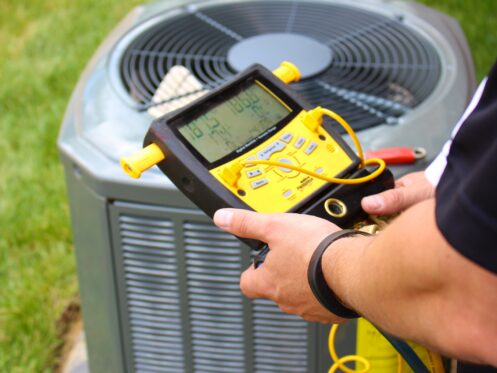
When your air conditioner starts up and during active cooling cycles, it uses more power than your electrical panel can supply. AC capacitors address this shortfall by collecting and storing energy. They then give the air conditioner the boost it needs to function seamlessly. With summer temperatures in Dallas, TX, often rising above 100 degrees Fahrenheit, a failed capacitor could spell disaster. From hard starts to persistent humming sounds, learn the early signs of impending capacitor failure and take action now.
Advanced Age
In ideal conditions, AC capacitors can last 10 to 15 years or longer. Unfortunately, conditions in Dallas are hardly ideal. Dallas has an exceedingly hot, humid climate that rapidly wears these components down. As a result, your AC capacitor could fail much sooner. If your air conditioner is 10 years old (or older) and has never had a capacitor replacement before, it may be time for a new capacitor now.
You can avoid sudden breakdowns by staying on top of annual AC maintenance. Schedule professional tune-up service before the start of every cooling season. Professional AC tune-ups include multi-point air conditioning inspections. They allow technicians to check these components for visible damage and make recommendations for a timely replacement.
Hard Starting
Most modern, residential ACs have a single capacitor that provides power for both start-up and active cooling cycles. Other air conditioners have separate “run” and “start” capacitors with separate functions. You might have a faulty dual capacitor or a faulty start capacitor if your AC has a hard time turning on.
- Clicking, buzzing, or humming sounds
- Stuttering or delayed starts
- Dimming or flickering lights
- Tripped circuit breakers
- Stalling just after starting
One Failed and One Working Capacitor
If you have run and start capacitors, having your start capacitor fail likely means that your run capacitor is on its way out, too. Replacing both capacitors at once will help you avoid additional issues in the near future.
Humming Noises
Even if your AC doesn’t have a hard time starting, loud humming noises may be an indication of capacitor problems. Even without sufficient electricity to power ACs through cooling cycles, failing capacitors can still send electricity to the compressor and fan motors.
Humming sounds come from this electrical supply as it charges motor coils. This creates a vibrating magnetic field that isn’t powerful enough to force rotation. Continuing to run your AC with a failed or failing capacitor will repeatedly stall its motors. It can also cause overheating and fan or compressor motor failure.
Frequent Stops and Starts
Also known as short-cycling, frequent stops and starts are an indication of a failing dual capacitor or a failing run capacitor. Short-cycling could mean that your capacitor still has the ability to get your AC “up,” but there’s not enough juice to keep it running.
The average AC cooling cycle lasts 15 to 20 minutes. When your AC functions as it should, it should cycle on just two to three times per hour. During short-cycling, cooling cycles last less than five minutes. In fact, cooling cycles could be as short as one to two minutes, and your air conditioner might cycle on five to 10 times each hour.
Visible Bulging or “Doming”
Whether due to hard starts or voltage spikes, failing capacitors often operate at higher-than-normal temperatures. Rising heat causes the dielectric materials within these components to break down and release gas. With nowhere to go, this gas distorts capacitors’ metal casing by forcing it to expand. This gives capacitors a bulging, domed look at their top.
During AC inspection and tune-up service, HVAC technicians check for doming. Homeowners are advised against tampering with or even inspecting capacitors on their own. Both electrical malfunctions and failure to properly disconnect the power supply could lead to potentially fatal electrocution.
Fluid Leaks
Capacitors with extreme internal heat and built-up pressure can also leak. As their casing distorts and cracks, capacitors can leak dielectric oil. This oil insulates and cools capacitors during operation. As it increasingly seeps out, relying on failing capacitors becomes increasingly hazardous.
Fan Problems
Humming fan motors are among the first signs of capacitor-related problems. Fans might repeatedly stop and start, emit smoke or burnt odors, or stop working entirely. Check your HVAC system’s air vents for weak or inconsistent airflow. Weak airflow could indicate a failing dual capacitor or a failing run capacitor.
Warm Air and Rising Humidity
Having warm air coming from your vents is also a sign of a failed or failing capacitor. Warm air might mean that your air conditioner’s capacitor is no longer capable of powering the compressor.
The compressor unit alternately pressurizes and depressurizes refrigerant to pump it throughout your cooling system. Cold refrigerant within the system’s evaporator coil extracts indoor heat, and hot refrigerant in the condenser coil sheds this heat outdoors. With insufficient compressor power, ACs will distribute lukewarm air.
Poor compressor performance can also lead to noticeable increases in indoor humidity over time. As your AC extracts indoor heat, it also extracts excess moisture. Capacitor-related problems, like poor refrigerant flow and short-cycling, can leave the interior of your home feeling damp, clammy, or muggy.
Longer and Ineffective Cooling Cycles
Air conditioners with failing capacitors could have longer and less effective cooling cycles, too. If your cooling cycles last 30 minutes or more and the temperature of your living space isn’t changing, turn your AC off. Having it inspected and repaired before turning it back on will prevent a potentially minor issue from escalating.
Rising Energy Bills
Air conditioners with failing capacitors have to work harder to get their job done, and they might not make a significant impact at all. But other factors relating to your capacitor could cause your energy bill to spike as well. For instance, when failing capacitors can no longer hold a charge, they force motors to draw higher amperage. In some cases, they may use 30% more energy overall.
Why AC Capacitors Have Shorter Lifespans in Dallas
AC capacitors have shorter-than-normal lifespans in Dallas and the surrounding areas due to the region’s humid, subtropical climate. With summer temperatures of 100 degrees Fahrenheit or higher, air conditioners operate under consistently high stress. This causes accelerated wear across all their components. Excess moisture in the air also accelerates the corrosion of capacitors’ metal parts. This increases the likelihood of bulging or doming and oil leaks.
How to Curb Capacitor Replacement Costs in Dallas
Although you can’t change the Dallas climate or its effect on AC capacitors, you can curb your capacitor replacement costs. Scheduling annual AC maintenance service reduces environmental wear. If your air conditioner has a run and start capacitor, you can also have your technician upgrade it to a single dual capacitor. This way, you’ll only have one capacitor to track, maintain, and replace over time.
What Will Happen If Your Capacitor Fails
Having an AC capacitor fail could leave you without whole-house cooling when you need it most. As the temperature in your Dallas home climbs, residents could develop heat-related health issues, such as heat stroke, extreme dehydration, and heat exhaustion. Using an AC with a failed or failing capacitor can also shorten the lifespan of your AC compressor, fan motors, and entire cooling system.
Take Action Now By Scheduling an AC Inspection
Don’t wait for a failing capacitor to stop working altogether before seeking help. Cut your energy costs, protect your household, and extend the lifespan of your AC by scheduling an AC inspection now. Cody & Sons Plumbing, Heating & Air offers comprehensive AC repair and inspection services. Proudly serving Dallas, Plano, and the surrounding communities for more than 50 years, we offer upfront pricing, online scheduling, and 24/7 phone support. Call Cody & Sons Plumbing, Heating & Air today to schedule an appointment!